

Rebuilding Oregon
One Spreadsheet at a Time
The other day I shared a set of graphics I’d been working on.
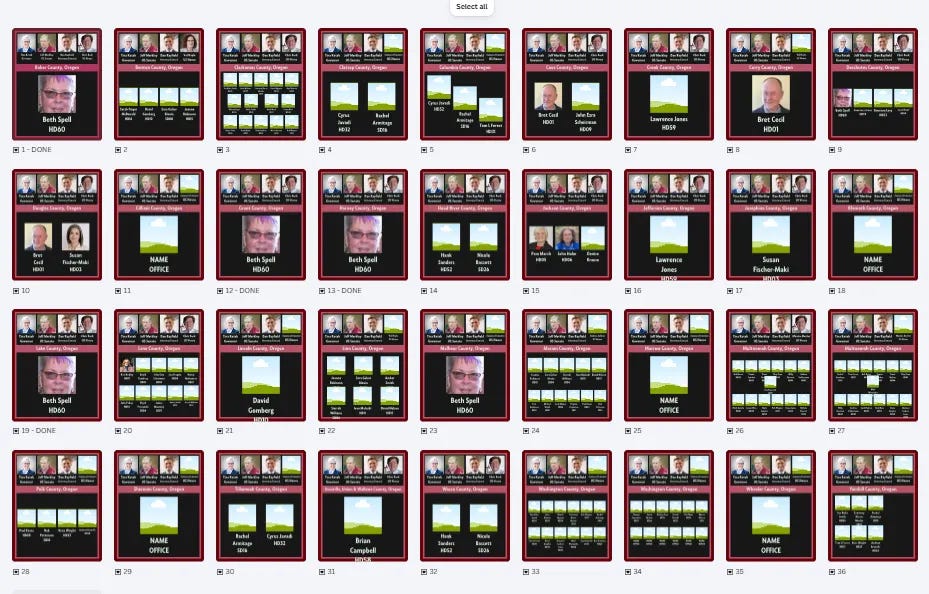
One graphic for every county in Oregon. Work in progress, clearly. Not the point.
Who’s on the ballot.
Who’s running.
Basic information.
The sort of thing that, at first glance, looks like the kind of project only someone with entirely too much time & entirely too many spreadsheets would undertake.
Which, fair.
The first draft was extra.
I know it was extra.
That was kind of the point.
“The graphics weren’t really the project.
The graphics were the side effect of the project.”
The real project was teaching myself Oregon.
Not Oregon-the-state-on-a-map.
Oregon-the-place.
The people.
The regions.
The relationships.
The stories.
The invisible threads connecting one town to another. Studying maps in phone books was more than a phase for me.
The reasons some places vote blue, some vote red, & some refuse to cooperate with anyone’s neat little narratives.
Because here’s the thing.
Before the TBI.
Before the stroke.
Before my brain decided to start playing life on hard mode.
I had what people would probably call a photographic memory.
Not in the movie sense.
More in the “accidentally memorized an entire county” sense.
I grew up in Humboldt County, California.
A place so isolated that reading the phone book qualified as entertainment.
The nearest library was half an hour away.
The nearest bus stop was five miles through a forest.
There were bears.
There were mountain lions.
There were weed grows.
And there was me.
Reading everything.
Phone books.
IRS publications.
Maps.
Newspapers.
Anything with information printed on it.
I didn’t know I was teaching myself how systems worked.
I thought I was just curious.
I wasn’t memorizing addresses.
I was memorizing relationships.
King Salmon had ocean-themed street names.
The 3300 block of Harris Street split two zip codes.
I could tell you which towns had libraries.
Which towns had post offices.
Which churches were welcoming.
Which churches were terrifying.
Which schools were rivals.
Which roads separated neighborhoods.
I wasn’t collecting facts.
I was building a map.
And once I understood the map, the details stuck themselves to it. Who among us hasn’t been grounded for not memorizing the Sunday School homework chapter you were assigned, amirite? No, no one else has religious trauma?
Moving on.
Then life happened.
A traumatic brain injury.
A stroke.
The sort of events that force you to renegotiate your relationship with your own mind.
I can still write.
Mostly.
The ideas are still there.
The patterns are still there.
But some of the machinery got scrambled.
I forget conventions. Ones I meticulously memorized. Got 100% test results consistently.
Now I forget whether a word is an adjective or an adverb. And frankly, no longer care, if I’m not getting grandkids, I’m not going to go relearn all the stuff I’m never going to need to remember to help any with their homework. ~SOBS~
Right, shake out my hair, where was I?
I drift between first & third person.
I occasionally stare at punctuation like it’s an unsolved murder. I have proudly graduated from needing a thesaurus tab open at all times. I can’t remember the last time I couldn’t remember my vocabulary word & needed to spend 10 minutes searching for the word just beyond my reach. I am MORTIFIED every time I catch a typo in my writing.
So now I write differently.
I dump everything onto the page.
Stories.
Politics.
Memories.
Observations.
Half-connected thoughts.
And then I do that thing I used to do so much of. All the speech writing, scripting, chatlog training, was the go-to person for help with court papers. I could polish a speech on the fly, just pulling the arm on a slot machine, rearranging, redefining, all things I never did for my own writing before. I’d been taught to write so meticulously well, scored at college levels in elementary school. All of 7th grade was memorizing descriptive words. If I wrote a 10 page essay, it was the first pass. I could not rewrite it. So, I didn’t. So something I did in rewiring my brain, opened that pathway.
Out comes something recognizable.
I’m my own ghostwriter.
My own editor. I worked in such high stakes, communicating on the fly environments, we could code switch between the absolutely fastest way to communicate information to sitting down with Oprah Winfrey. So when I wrote something, that was it. It was spotless. I felt SHAME when I got a red squiggly when I was typing. I had failed that days pop quiz.
Once upon a time I worked on a project, Comment Generator. Think early days mad libs kinda thing. We programmed a bunch of phrases, we factored for rules, we hand input the potential words. Almost a flow chart of text. My word calculator.
These days, I build memory instead of stumbling into it.
So I make spreadsheets nobody asked for.
County populations.
Voter registrations.
Legislative districts.
Media markets.
Election returns.
Candidate recruitment.
County party infrastructure.
Every rabbit hole Oregon has to offer.
Not because I need another spreadsheet.
God knows I do not need another spreadsheet. It could be worse, I could collect purses.
But I need to see the information.
Move it around.
Organize it.
Interact with it long enough for it to become understanding.
Occupational therapy disguised as political nerdery.
Or political nerdery disguised as occupational therapy.
The distinction feels increasingly academic.
Take Deschutes County.
Someone tells you it’s rural.
They’re right.
Someone tells you it’s blue.
They’re right too.
Welcome to Oregon.
Nothing is ever as simple as the map suggests.
Every county tells a story.
Some have thriving activist networks.
Some are being held together by three exhausted volunteers, a Facebook page nobody can access, & pure spite. Some got accounts in a divorce.
Some have offices.
Some don’t.
Some are growing.
Some are shrinking.
Some are changing faster than anyone realizes.
And every one of them matters.
Because the map is not the territory.
The people are.
That’s what I’ve been trying to learn.
Not where Baker County is.
What Baker County means.
Who lives there.
What keeps them up at night.
Who is already doing the work.
How we can help.
How communities connect to each other.
How information travels.
How trust travels.
How hope travels.
Because that’s the work I’ve always cared about. Not for nothing, it’s why even thought I just switched my party to Working Families Party, I’ll always be a Jamie McLeod-Skinner Democrat. We share a passion for doing real work, not collecting awards. We did that already. Now it’s about the people around us we can help.
Connecting people.
Building bridges.
Helping folks find each other.
And maybe that’s where this gets more personal than I intended.
Because while I’ve been teaching myself Oregon, I’ve also been relearning something else.
Scale.
For years my world kept getting bigger.
More platforms.
More projects.
More campaigns.
More organizations.
More people.
National work.
International work.
Hundreds of conversations.
Thousands of conversations.
Literally billions of people moving through my orbit. I’ve done some REALLY famous work under other names. There are breadcrumbs & NDAs though.
And somewhere along the way I realized that being connected to everyone isn’t the same thing as feeling connected.
So lately I’ve been moving in the opposite direction.
Closer to home.
Closer to Oregon, paying more attention to Humboldt again.
Closer to the people I’ll actually see again.
Closer to family.
Closer to neighbors.
Closer to conversations that continue next week instead of disappearing into the algorithm forever.
I don’t need a bigger audience anymore.
I think I want deeper roots.
I want to know Oregon.
I want to know the people who live here.
I want to call my nieces more often.
I want to spend less time tracking the entire world & more time paying attention to the places & people I can still reach.
Maybe that’s another reason I keep making these ridiculous spreadsheets.
Maybe I’m not just building a map of Oregon.
Maybe I’m rebuilding a map of home.
One county.
One conversation.
One connection at a time.
~AK